Eight movements, practiced for nearly a thousand years
Baduanjin (八段錦, the "eight pieces of brocade") is one of the most widely practiced forms of qigong in the world. Each movement pairs slow, deliberate motion with deep, steady breathing. The exercises are illustrated as far back as Song Dynasty texts, and people still practice them every morning in parks, studios, and living rooms.
Most courses teach one version. This one teaches three: the traditional standing set, the standing set as preserved in Korea's Moo Duk Kwan tradition, and a rarely taught seated set you can do on the floor or in a chair.
Learn one, or learn all three. Each stands on its own as a complete daily practice.
Three ways to practice
Standing
Traditional Baduanjin
Ba Duan Jin · 八段錦- The classic set practiced worldwide
- Eight standing movements for the whole body
- Full set in about 7 minutes
- A great first set if you're new to qigong
Standing
Moo Duk Kwan Baduanjin
Moo Pahl Dan Kuhm · 武八段錦- The Korean version, reordered with an added posture
- Deeper stances and stronger breath work
- Full set in about 8 minutes, plus a 30-minute class
- Ideal as a morning routine, warm-up, or cool-down
Seated
Seated Baduanjin
Moon Pahl Dan Kuhm · 文八段錦- A rarely taught set, done on the floor or in a chair
- Gentle work for the neck, spine, back, and hips
- Full follow-along set in about 20 minutes
- Ideal for quiet practice, recovery, or limited mobility
CURRICULUM
What's included
- 3
- complete sets
- 32
- video lessons
- 3½
- hours of instruction, approx.
- 2
- printable guides
Every set is taught the same way: an introduction, each of the eight movements step by step, and the full set start to finish.
- Traditional Baduanjin~32 min
- Moo Duk Kwan BaduanjinWith a printable handout~33 min
- Seated BaduanjinWith a 20-minute follow-along set and a printable manual~40 min
- Bonus classesA 30-minute standing follow-along class and a 75-minute in-depth seminar105 min
Who this course is for
Anyone looking for a gentle daily practice
No experience needed. A few minutes each morning to breathe deeply, loosen stiff joints, and start the day clear-headed.
Older adults and anyone easing back into movement
Low-impact and self-paced. On days when standing practice isn't right, the seated set keeps the habit going.
Tai Chi and Qigong practitioners
See three versions of the Eight Brocades side by side, including a seated set few practitioners have encountered.
Martial artists of any style
A complete internal practice for warm-ups, cool-downs, and recovery days, taught in the Moo Duk Kwan tradition.
All three sets breathe from the dan jun (丹田), a point about three inches below the navel. On the inhale, the belly and lower back expand in every direction, like a bellows. On the exhale, they gently contract. It's the way a newborn breathes, and most adults have simply forgotten it.
Before any movement, the course teaches three breaths:
- 1 Cleansing breathIn through the nose, out through the mouth
- 2 Natural breathIn and out through the nose
- 3 Closing the breathA complete inhale or exhale, followed by a short, comfortable pause
Standing · Ba Duan Jin
Traditional Baduanjin
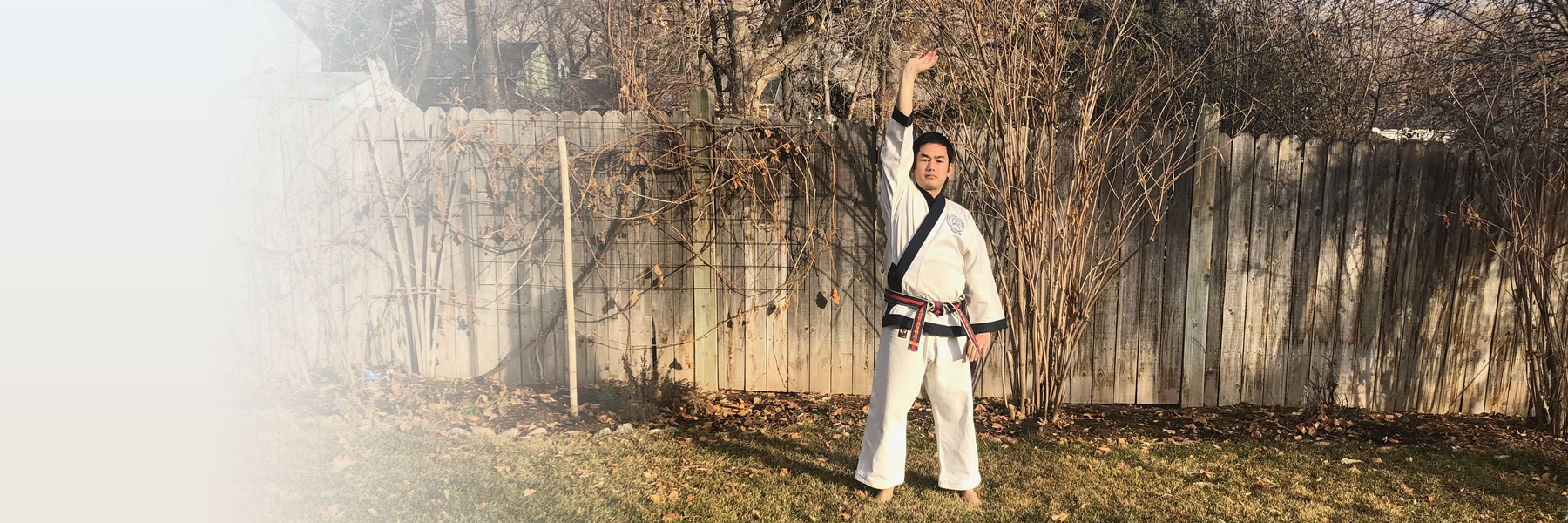
- 1Support the heavensLift both arms overhead to open the chest and lengthen the body.雙手托天
- 2Draw the bowOpen the chest and shoulders as if drawing a bow to each side.左右開弓
- 3Raise one handOne arm reaches up, one presses down, stretching the sides and abdomen.單擧手
- 4Look backwardTurn the head and spine gently to each side.向後瞧
- 5Swing the head and tailA low, circling stance that opens the hips and mobilizes the spine.揺頭擺尾
- 6Hold the feetFold forward to stretch the lower back and hamstrings.兩手攀足
- 7Punch with angry eyesSlow, focused punches from a low stance to build strength.攢拳怒目
- 8Shake the backRise onto the toes and drop gently to the heels to settle the whole body.背後七顛
Standing · Moo Pahl Dan Kuhm
Moo Duk Kwan Baduanjin
Preserved by Grandmaster Hwang Kee, founder of the Moo Duk Kwan, this version reorders the set and adds a posture.
- 1Support the heavensWarm the body and expand the chest with a held breath.雙手擎天
- 2Draw the bow to shoot the eagleA deep chest stretch with a strong squeeze between the shoulder blades.左右開弓似射雕
- 3Punch with angry eyesSlow punches from a deep stance, settling the breath low.握拳怒目
- 4Raise the handOpposing arms reach to heaven and earth, stretching the sides and abdomen.單擧手
- 5Hold the feetA gentle back bend, then a slow forward fold for the back and hamstrings.兩手攀腳
- 6Swing the head and tailCircle the torso from a low stance to open the hips.揺頭擺尾
- 7Extending claws, spreading wingsPush the palms forward on a long exhale, stretching the chest and upper back.出爪亮翅
- 8Shake the backRise and drop to the heels, sinking the weight to the dan jun.背後七顛
Seated · Moon Pahl Dan Kuhm
Seated Baduanjin
Practiced on the floor or in a firm chair. Grandmaster Hwang Kee published this set and taught it at his 1984 clinics, and it has rarely been taught since. This course draws on the working notes of his son, H.C. Hwang, who learned it from him.
- 1Still the mindEyes closed, mind quiet but alert. Warm the hands and settle the breath.閉目冥心坐
- 2Sound the heavenly drumPalms cover the ears while the fingers tap the base of the skull.鳴天鼓
- 3The red dragon stirs the waterThe tongue circles the mouth, and the saliva is swallowed slowly in three parts.赤龍攪水津
- 4Rub the lower backWarm the hands and massage the kidneys with a held breath.背摩後精門
- 5Hold the feetExtend the legs, lower the head, and stretch toward the toes.低頭攀足頻
- 6Turn the windlassShoulders circle left and right, moving with the breath.左右轆轤轉
- 7Shake the heavenly pillarSlow, controlled turns of the head and neck.微擺撼天柱
- 8The river chariotGuide warmth up the spine and back down to the belly to close the set.河車搬運
Questions about Baduanjin
What is Baduanjin?
Baduanjin, or the Eight Brocades, is a form of qigong: a set of eight gentle movements paired with deep, steady breathing. It's practiced worldwide for mobility, balance, and a calmer mind.
Do I need any experience?
No. Every movement starts from a simple position, and the breathing is explained before any movement begins. No martial arts or qigong background is needed.
Which set should I start with?
Most beginners start with Traditional Baduanjin. Choose Seated Baduanjin if standing is difficult or you want a quieter practice, and Moo Duk Kwan Baduanjin if you want deeper stances and more breath work. Many people end up rotating all three.
How are the three sets different?
The two standing sets share the same roots and the same name (八段錦). The Moo Duk Kwan version, preserved in the Korean martial arts tradition, reorders the movements and adds a posture. The seated set is a separate group of eight exercises that work the neck, spine, back, and hips while focusing on the breath and mind.
How long does it take, and how often should I practice?
The standing sets take 7 to 8 minutes each, and the seated follow-along set about 20. Baduanjin is traditionally practiced in the morning, and the benefits build with daily practice.
Is it safe if I'm older or working around an injury?
All three sets are low impact and self-paced, and the seated set can be done entirely in a chair. Hold the breath only as long as is comfortable, never to dizziness, move the neck slowly, and don't practice on a full stomach. If you have a medical condition, check with your doctor first.
What do I need?
For the standing sets, enough room to stretch your arms in every direction. For the seated set, a spot on the floor or a firm chair with a straight back. No equipment, uniform, or mat required.
I already own this course. Do I get the seated set?
Yes. Seated Baduanjin has been added to the same course at no additional cost. Log in and you'll find it in your curriculum.
Can my family use it too?
Yes. One purchase covers everyone in your household.
What if the course isn't right for me?
You can request a full refund within 7 days of purchase, as long as no files have been downloaded. See the refund policy.